Are Dogs
Color Blind?
The truth about canine vision — and what it means for your pet
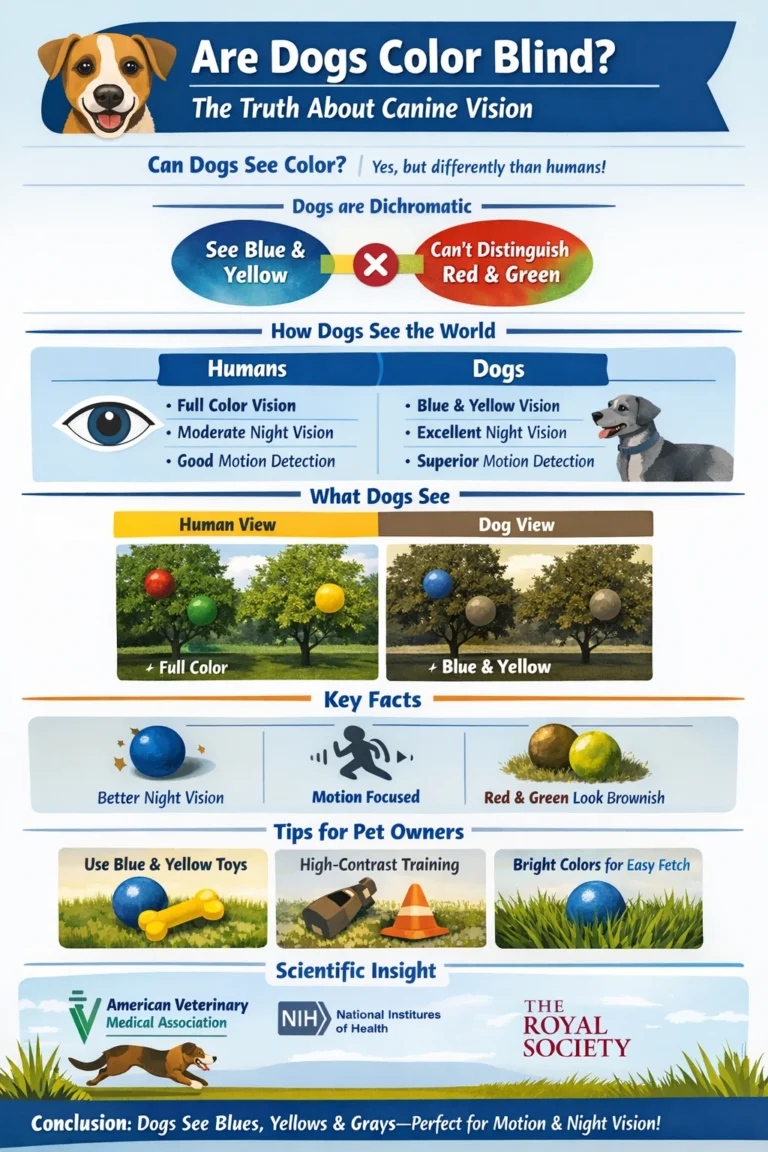
One of the most common questions pet parents ask is: "Are dogs color blind?" The short answer is yes — but not in the way most people think. Dogs do see colors, just not the full spectrum that humans do. Understanding how your dog sees the world can help you make better choices when it comes to toys, training, and overall care.
What Dogs Actually See
Dogs are not completely color blind. Instead, they have a condition similar to red-green color blindness in humans. Humans have three types of color-detecting cells (cones), while dogs only have two — which changes their entire color world.
👁️ Dogs CAN See
- Blue
- Yellow
- Shades of gray
⚠️ Dogs Struggle With
- Red
- Green
- Orange
Colors like red, green, and orange often appear as shades of brown or gray to dogs. That bright red ball on green grass? Your dog might not see it at all.
The Science Behind It
Scientific research in veterinary ophthalmology confirms that dogs are dichromatic — meaning they rely on only two types of cone cells. Studies from the Journal of Vision and the Proceedings of the Royal Society B explain that canine vision evolved for survival, not color appreciation.
Key Scientific Findings
More rods, fewer cones — Dogs have far more rod cells than humans, giving them exceptional night vision and motion detection at the cost of color range.
Motion optimized — Canine vision is wired to detect movement, not distinguish colors. A stationary object may be invisible; a moving one is instantly spotted.
Low-light superiority — Dogs see significantly better than humans in dim light, making them naturally adapted for dawn and dusk activity.
Why Did Dogs Evolve This Way?
Dogs are descendants of wolves, and their vision adapted for survival in the wild — hunting at dawn and dusk, tracking moving prey, and navigating low-light environments. Color differentiation was simply less important than motion sensitivity and night vision.
Dogs vs. Humans — Vision Compared
| Feature | Humans | Dogs |
|---|---|---|
| Color Vision | Trichromatic (3 cones) | Dichromatic (2 cones) |
| Night Vision | Moderate | Excellent |
| Motion Detection | Good | Superior |
| Visual Sharpness | High | Lower than humans |
Practical Tips for Pet Parents
Choose the Right Toys
Pick blue or yellow toys — your dog will see them clearly. Avoid red or green toys, especially on grass.
Smarter Training
Use high-contrast objects and pair visual cues with sound commands for best results.
Outdoor Play
A red ball on green grass is nearly invisible to your dog. Opt for a bright blue ball instead.
Busting Common Myths
Myth — Dogs see only in black & white
False. Dogs do see colors — specifically blue and yellow. They're not seeing a black-and-white movie, just a more limited palette than us.
Myth — Dogs have poor vision overall
Not entirely true. While they lack color detail, dogs excel in motion detection and night vision — two areas where they significantly outperform humans.
Supporting Research
American Veterinary Medical Association
Veterinary insights into animal sensory perception and vision research.
National Institutes of Health
Hosts studies on photoreceptor function and mammalian vision systems.
The Royal Society
Published landmark research on dichromatic vision in mammals.
Cornell University — Veterinary Medicine
Research-backed insights into animal physiology and canine vision.
The Takeaway
Dogs live in a world of blues, yellows, and grays — vision perfectly adapted for survival rather than color richness. For pet parents, this knowledge is practical gold. From choosing toys to training methods, understanding your dog's vision can meaningfully enhance their quality of life.
Shop Dog Supplements →
