
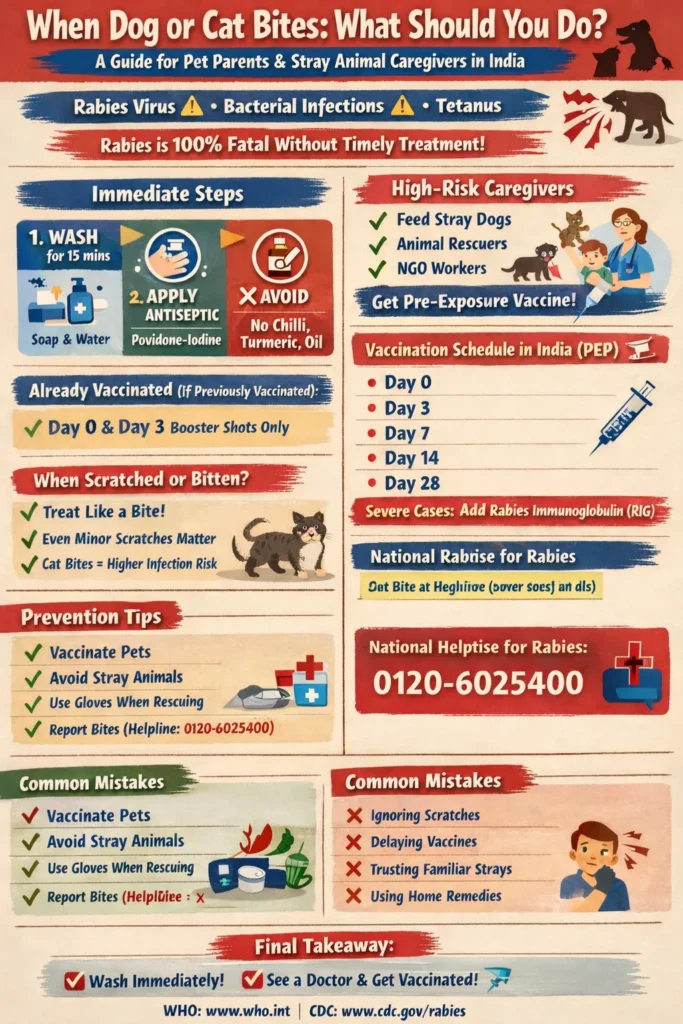
A Complete Guide for Pet Parents & Stray Animal Caregivers in India
When Dog or Cat Bites: Why Immediate Action Matters
A dog bite or cat bite is not “just a small injury.” In India, where rabies remains endemic, even a tiny scratch from a dog or cat can become a medical emergency.
Every year, thousands of people in India require rabies vaccination after being bitten or scratched by dogs and cats. The greatest danger is not only the physical wound itself, but also the possibility of exposure to:
- Rabies virus
- Serious bacterial infections
- Tetanus
- Deep tissue injury involving nerves, tendons, or muscles
Rabies deserves special attention because once symptoms begin, the disease is almost always fatal. However, rabies is also one of the few deadly diseases that can be completely prevented if treatment begins immediately after exposure.
The most important rule is simple:
If a dog or cat bites or scratches you, act immediately—even if the wound seems tiny.
What Happens When a Dog or Cat Bites You?
When an infected dog or cat bites, the saliva may enter the body through:
- Broken skin
- A puncture wound
- A scratch
- Existing cuts or abrasions
- Eyes, mouth, or nose if contaminated saliva reaches these surfaces
The rabies virus does not spread through blood. It spreads mainly through infected saliva.
After entering the body, the virus initially stays near the wound. It then enters peripheral nerves and slowly travels toward the spinal cord and brain.
This is why there is usually a delay—called the incubation period—between the bite and symptoms.
The incubation period may range from:
- A few days
- Several weeks
- Several months
- Rarely more than a year
The closer the bite is to the head, neck, face, or hands, the faster the virus may reach the brain because these regions have a rich nerve supply.
High-risk bite locations include:
- Face
- Lips
- Eyelids
- Neck
- Fingers
- Hands
- Genitals
Once the virus reaches the brain, symptoms begin. At that stage, treatment no longer works.
Early Symptoms of Rabies in Humans
The first symptoms of rabies may resemble a viral fever and can include:
- Fever
- Weakness
- Headache
- Body pain
- Tingling, burning, or numbness around the bite wound
As the disease progresses, more serious symptoms appear:
- Anxiety
- Confusion
- Difficulty swallowing
- Fear of water (hydrophobia)
- Fear of air movement or wind (aerophobia)
- Excessive salivation
- Hallucinations
- Paralysis
- Coma
Once these symptoms appear, survival is extremely rare.
This is why prevention before symptoms begin is essential.
When Dog Bites: What To Do Immediately
The first 15 minutes after a dog bite or cat bite are extremely important.
Step 1: Wash the Wound Immediately for 15 Minutes
Wash the bite or scratch under running water using soap for at least 10–15 minutes.
Use:
- Running tap water
- Soap or detergent
- Plenty of water
Do not simply rinse for a few seconds. Proper washing physically removes and dilutes the virus from the wound.
Scientific studies show that immediate wound washing can dramatically reduce the amount of rabies virus in the tissue.
If running water is unavailable, repeatedly pour clean water over the wound.
Do not scrub harshly because this may damage tissue further.
Step 2: Apply an Antiseptic
After washing, apply an antiseptic that can help kill remaining virus particles.
Recommended options include:
- Povidone-iodine
- Chlorhexidine
- Alcohol-based antiseptic if nothing else is available
Povidone-iodine is preferred because it has strong virucidal activity.
Step 3: Control Bleeding
If the wound is bleeding heavily:
- Apply gentle pressure with a clean cloth or sterile gauze
- Elevate the affected body part if possible
Minor bleeding can actually help flush contaminants out of the wound. Therefore, avoid tightly compressing a small bite immediately.
Should Dog Bite Wound Be Covered?
One of the most common questions is: Should dog bite wound be covered?
The answer depends on the stage of care.
Immediately after washing:
- Do not tightly cover the wound
- Do not seal it with thick ointments or tight bandages
- Do not close it with tape at home
A tightly covered wound can trap bacteria and increase the risk of infection.
However, after the wound has been cleaned and examined, a healthcare professional may place:
- A loose sterile dressing
- Light gauze
- A breathable bandage
The purpose is to:
- Keep the wound clean
- Prevent contamination
- Reduce bleeding
Deep puncture wounds, especially from cat bites, usually should not be tightly closed because bacteria can remain trapped deep inside.
If a doctor decides that stitches are necessary, they are usually delayed or placed loosely after rabies immunoglobulin has been infiltrated into the wound.
When You Should Cover the Wound
You may lightly cover the wound if:
- It is still bleeding
- You are travelling to the hospital
- There is risk of dirt entering the wound
Use:
- Sterile gauze
- Clean cotton cloth
- Loose medical dressing
Avoid:
- Airtight plastic
- Tight bandages
- Home remedies under the bandage
What You Should Never Put on a Dog Bite Wound
In India, many traditional remedies are still used after a dog bite. These remedies are dangerous and should never be used.
Do NOT apply:
- Chilli powder
- Turmeric paste
- Oil
- Mud
- Ash
- Lime
- Toothpaste
- Herbal paste
- Coffee powder
- Burnt cloth
These substances:
- Do not kill rabies virus
- Delay proper treatment
- Increase the risk of bacterial infection
- Make the wound more difficult for doctors to clean
WHO Dog Bite Classification
The World Health Organization has developed an internationally accepted system called the WHO dog bite classification or WHO dog bite category system.
This system helps determine whether a person needs rabies vaccination and immunoglobulin.
The WHO dog bite classification divides exposure into three categories.
WHO Dog Bite Category I
Category I is the lowest-risk situation.
Examples include:
- Touching a dog or cat
- Feeding an animal
- Licks on intact skin
- Being near a dog without actual contact
In WHO dog bite Category I:
- The skin is not broken
- Saliva does not enter the body
- There is no true exposure
Treatment for Category I
- Wash the area with soap and water
- No rabies vaccine is needed
- No rabies immunoglobulin is needed
Example:
A dog licks your hand but you have no cuts or scratches. This is Category I.
WHO Dog Bite Category II
WHO dog bite Category II includes minor exposure.
Examples:
- Minor scratches without bleeding
- Nibbling on uncovered skin
- Superficial abrasions
- Tiny scratch marks from a dog or cat
Even if there is no visible bleeding, the skin barrier may still be broken.
Treatment for Category II
For WHO dog bite Category II, you need:
- Immediate wound washing
- Rabies vaccine
- Medical evaluation
Rabies immunoglobulin is usually not required for Category II.
Example:
A stray puppy scratches your ankle and leaves a faint red line without bleeding. This is still Category II and requires vaccination.
WHO Dog Bite Category III
WHO dog bite Category III is the most serious type of exposure.
Examples include:
- Single or multiple bites that break the skin
- Deep scratches with bleeding
- Saliva entering an existing wound
- Licks on broken skin
- Saliva entering the eyes, nose, or mouth
- Bites on face, hands, fingers, neck, or genitals
Treatment for Category III
WHO dog bite Category III requires:
- Immediate wound washing
- Rabies vaccine
- Rabies immunoglobulin (RIG)
- Urgent medical care
Category III is considered a medical emergency.
WHO Dog Bite Table: Categories and Treatment
| WHO Dog Bite Category | Exposure Type | Vaccine Needed? | Rabies Immunoglobulin Needed? |
| Category I | Lick on intact skin, touching animal | No | No |
| Category II | Minor scratches, abrasions without bleeding | Yes | No |
| Category III | Bite, bleeding scratch, saliva on broken skin | Yes | Yes |
When Dog Scratches You: Is It Dangerous?
Many people think only a bite can spread rabies. This is incorrect.
A dog scratch or cat scratch can also spread rabies if saliva is present on the claws or the skin is broken.
Treat any scratch exactly like a bite if:
- The skin is broken
- There is even slight bleeding
- The animal is stray or unvaccinated
- You are unsure whether saliva touched the wound
Cat scratches and cat bites deserve special attention because cats often groom themselves and may have saliva on their claws.
Cat Bites Are More Dangerous Than Many Dog Bites
Cat bites often look small but are medically important.
Because cats have sharp, narrow teeth, they create deep puncture wounds that:
- Trap bacteria deep in tissue
- Heal on the surface too quickly
- Become infected easily
Common bacterial infections after cat bites include:
- Pasteurella infection
- Cellulitis
- Abscess formation
You should seek medical care immediately after a cat bite, especially if the bite is on the hand.
Signs That a Dog Bite Is Becoming Infected
A bite wound can become infected within 24–72 hours.
Warning signs include:
- Redness increasing around the wound
- Swelling
- Pus
- Bad smell
- Fever
- Warmth around the area
- Increasing pain
- Difficulty moving the affected body part
See a doctor urgently if these symptoms appear.
Tetanus Risk After Dog or Cat Bite
A dog bite can also expose you to tetanus.
Tetanus is caused by bacteria that produce a toxin affecting the nervous system.
You may need a tetanus injection if:
- Your last tetanus vaccine was more than 5 years ago
- You do not remember your vaccination status
- The wound is deep or dirty
Doctors may give:
- Tetanus toxoid vaccine
- Tetanus immunoglobulin in certain situations
Rabies Vaccine After Dog Bite: How Many Injections?
If you have never received rabies vaccine before, the standard post-exposure schedule in India is usually:
- Day 0
- Day 3
- Day 7
- Day 14
- Day 28
Day 0 means the day of the bite or the day treatment begins.
It is very important not to miss any dose.
Each dose stimulates the immune system to produce antibodies against rabies.
If you delay or skip doses, protection may be incomplete.
Rabies Immunoglobulin (RIG): Why It Is Needed
Rabies immunoglobulin is required in WHO dog bite Category III exposure.
RIG provides immediate antibodies before the vaccine starts working.
There are two major types:
- Human Rabies Immunoglobulin (HRIG)
- Equine Rabies Immunoglobulin (ERIG)
The doctor injects RIG:
- Into and around the wound
- On Day 0 only
RIG should never be injected in the same site as the rabies vaccine.
RIG is especially important if:
- The bite is deep
- The bite is on the face or hand
- There are multiple wounds
- The animal is suspected to be rabid
If You Were Already Vaccinated Before
If you previously completed a rabies vaccination course, treatment after a new bite is different.
You need only:
- Day 0 booster dose
- Day 3 booster dose
You do NOT need rabies immunoglobulin.
This is especially important for:
- Animal rescuers
- Shelter workers
- Street dog feeders
- Veterinarians
Pre-Exposure Rabies Vaccine for Animal Caregivers
People who frequently interact with dogs and cats are considered high risk.
This includes:
- People who feed stray dogs daily
- Animal rescuers
- Shelter staff
- NGO workers
- Veterinarians
- Pet groomers
- Municipal dog handlers
WHO recommends pre-exposure rabies vaccination for such individuals.
The traditional schedule is:
- Day 0
- Day 7
- Day 21 or Day 28
Newer recommendations in some settings also allow a 2-dose schedule:
- Day 0
- Day 7
Even after pre-exposure vaccination, you must still take booster doses after a bite.
How Long Does Rabies Vaccine Protection Last?
For most people, protection after pre-exposure vaccination may last up to 3 years.
After that, you may need:
- A booster dose
- Antibody testing
People with repeated exposure may need boosters every 1–3 years.
When Dog Bite Injection Is Delayed
Many people panic if they could not start treatment immediately.
The good news is that you should still start treatment even if several days have passed.
You should take the vaccine even if:
- 1 day has passed
- 3 days have passed
- 1 week has passed
The only time vaccination no longer helps is after symptoms of rabies begin.
However, the sooner treatment starts, the safer you are.
What If the Dog Appears Healthy?
Many people avoid treatment because the dog looked healthy.
This is risky.
A dog can spread rabies before it shows obvious symptoms.
If the dog is available, it should be observed for 10 days.
If the dog remains healthy for 10 days, your doctor may reassess the need for further doses.
However, never delay starting treatment while waiting to observe the animal.
Dog Bite During Pregnancy: Is Vaccine Safe?
Rabies vaccine is safe during:
- Pregnancy
- Breastfeeding
- Childhood
- Old age
There is no minimum age for receiving rabies vaccine if exposure occurs.
A pregnant woman should never avoid treatment after a bite.
Should Antibiotics Be Taken After a Dog Bite?
Not every dog bite requires antibiotics, but many do.
Doctors commonly prescribe antibiotics if:
- The bite is deep
- The bite is on the hand or face
- It is a cat bite
- There are signs of infection
- The person has diabetes or low immunity
Commonly used antibiotics may include:
- Amoxicillin-clavulanate
- Alternative medicines for people allergic to penicillin
Do not start antibiotics without medical advice.
What To Eat After Dog Bite
There is no special “dog bite diet,” but proper nutrition helps the body respond better to vaccines and heal faster.
Eat:
- Eggs
- Dal
- Milk
- Fish
- Chicken
- Fruits rich in vitamin C
- Nuts and seeds
- Green vegetables
Drink enough water.
Avoid:
- Alcohol
- Smoking
- Excess junk food
- Starvation or crash dieting
There is no scientific evidence that milk, curd, spicy food, chicken, or fish interfere with rabies vaccine.
Common Myths About Dog Bite and Rabies
Myth 1: Small scratches do not matter
False. Even a tiny scratch can be WHO dog bite Category II.
Myth 2: If the dog is known to you, vaccine is unnecessary
False. Even pet dogs can bite if infected.
Myth 3: Home remedies can stop rabies
False. Only vaccine and immunoglobulin can prevent rabies.
Myth 4: You should wait to see if symptoms develop
False. Once symptoms develop, treatment usually fails.
Myth 5: Covering the wound tightly helps healing
False. Tight covering can trap bacteria.
When You Must Go to the Hospital Immediately
Seek emergency care immediately if:
- The bite is on the face or neck
- The wound is deep
- There is heavy bleeding
- A child has been bitten
- The animal was stray, aggressive, or behaving strangely
- The bite occurred from a bat, monkey, dog, or cat
- You have diabetes, cancer, or weak immunity
National Rabies Helpline in India
If you are unsure what to do after a bite, contact the national rabies helpline:
0120-6025400
You should also contact local hospitals, district hospitals, or government health centres for rabies vaccine availability.
When Dog Bites What Happens
When a dog or cat bites—or even scratches—you may be exposed to:
- Rabies virus (via saliva entering broken skin)
- Severe bacterial infections
- Tetanus
According to the World Health Organization, rabies is almost 100% fatal once symptoms begin, but completely preventable with timely treatment.
Scientific evidence shows the virus travels through nerves to the brain, which is why early intervention is critical.
Special Section: Stray / Community Animal Caregivers
If you:
- Feed stray dogs daily
- Rescue injured animals
- Run shelters or NGOs
You fall under high-risk category (WHO)
WHO Recommendation:
- Pre-exposure rabies vaccination (PrEP) is strongly advised for caregivers (CDC)
When Dog Bite: How Many Injections?
Post-Exposure Vaccination (PEP)
Standard schedule in India:
- Day 0
- Day 3
- Day 7
- Day 14
- Day 28
In severe cases:
- Add Rabies Immunoglobulin (RIG) on Day 0
If Already Vaccinated (Important WHO Guidance)
If you had prior rabies vaccination:
- Only 2 booster doses (Day 0 & Day 3) are needed
- No RIG required
This is critical for regular caregivers.
State-wise Rabies Treatment Centres in India
Below is an list across major Indian states:
West Bengal
- School of Tropical Medicine Kolkata
- Infectious Diseases and Beliaghata General Hospital
Delhi
- Safdarjung Hospital
- All India Institute of Medical Sciences
Maharashtra
- Naidu Infectious Diseases Hospital
- KEM Hospital
Tamil Nadu
- Rajiv Gandhi Government General Hospital
Karnataka
- Victoria Hospital
Telangana
- Gandhi Hospital
Uttar Pradesh
- IMS BHU Trauma Centre
Gujarat
- Civil Hospital Ahmedabad
- Surat Municipal Institute of Medical Education & Research
Rajasthan
- SMS Hospital Jaipur
Madhya Pradesh
- Hamidia Hospital Bhopal
Kerala
- Government Medical College Thiruvananthapuram
Punjab
- Government Medical College Amritsar
Bihar
- PMCH Patna
Odisha
- SCB Medical College Cuttack
Additionally:
- All District Hospitals & PHCs provide rabies vaccines under government programs
Common Mistakes (Especially Caregivers)
❌ Ignoring scratches
❌ Delaying vaccines
❌ Trusting familiar strays blindly
❌ Using home remedies
✔ Even friendly animals can bite when scared or injured
Prevention Tips
For pet parents & caregivers:
- Vaccinate pets regularly
- Avoid handling unknown animals
- Use gloves when rescuing
- Support sterilization programs
- Take pre-exposure vaccine if frequently exposed
Final Takeaway: What To Do When Dog or Cat Bites
If a dog or cat bites or scratches you:
- Wash immediately with soap and water for 15 minutes
- Apply povidone-iodine or antiseptic
- Do not apply chilli, turmeric, oil, or other home remedies
- Do not tightly cover the wound
- Seek medical help immediately
- Follow WHO dog bite category recommendations
- Take all vaccine doses on time
- If it is WHO dog bite Category III, get rabies immunoglobulin
Remember:
- Even a minor scratch may need treatment
- A healthy-looking dog can still spread rabies
- Rabies is fatal after symptoms start
- Rabies is completely preventable if treated early
The safest decision is always to seek medical care immediately after any dog or cat bite.
Animal bites are not just accidental injuries—they are medical emergencies, especially in India where rabies remains endemic. Whether you are a pet parent or someone who feeds and rescues community dogs and cats, knowing what to do can save lives.
When dog bites what to do?
✔ Wash immediately
✔ Take vaccine on time
When dog bite injection is delayed → risk increases
For caregivers:
✔ Consider pre-exposure vaccination
✔ Stay updated with boosters
References (With Links)
- WHO Rabies Guidelines
https://www.who.int - CDC Rabies Pre-Exposure Prophylaxis
https://www.cdc.gov/rabies/hcp/clinical-care/pre-exposure-prophylaxis.html (CDC) - WHO Rabies Vaccination Schedule
https://cdn.who.int/media/docs/default-source/searo/india/health-topic-pdf/pep-prophylaxis-guideline-15-12-2014.pdf (WHO CDN) - CDC Yellow Book (Rabies Duration & Immunity)
https://www.cdc.gov/yellow-book/hcp/travel-associated-infections-diseases/rabies.html (CDC) - Rabies Vaccine Age & Schedule
https://www.cdc.gov/yellow-book (CDC)

