
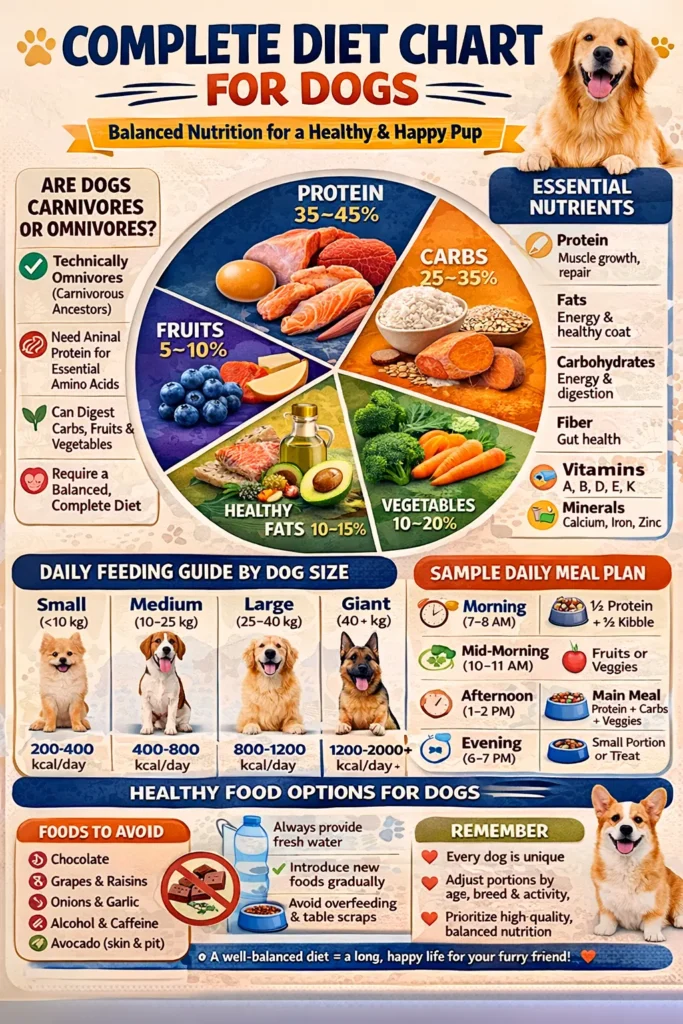
One of the most debated topics among pet parents is: “Are dogs carnivores or omnivores?”
While dogs belong to the biological order of carnivores, modern science shows that their dietary needs are more complex. Understanding your dog’s nutritional classification is crucial for making informed feeding decisions and ensuring long-term health.
Are Dogs Carnivores or Omnivores?
Dogs are technically omnivores with carnivorous ancestry.
They belong to the order Carnivora, but their digestive system and metabolism have evolved to process both animal-based and plant-based foods.
👉 In simple terms:
- Biologically: Carnivores
- Functionally: Omnivores
The Science Behind Canine Diet Evolution
Scientific research published in journals like the Nature and Proceedings of the National Academy of Sciences provides strong evidence of dietary adaptation in dogs.
Key Study Insight:
A landmark study found that domesticated dogs have developed genes that help digest starch, unlike their wolf ancestors.
What This Means:
- Dogs can digest carbohydrates efficiently
- They can derive nutrients from grains and vegetables
- Their metabolism adapted alongside human diets
Carnivores vs Omnivores: What’s the Difference?
| Feature | Carnivores | Omnivores (Dogs) |
| Diet | Meat only | Meat + plant-based food |
| Digestive Enzymes | Limited for carbs | Can digest starch |
| Teeth Structure | Sharp tearing teeth | Mixed (tearing + grinding) |
| Examples | Cats | Dogs, Humans |
Anatomy of a Dog’s Digestive System
Dogs still retain many carnivorous traits:
- Sharp teeth for tearing meat
- Strong stomach acid for protein digestion
- Shorter digestive tract compared to herbivores
However, they also have:
- Enzymes like amylase for starch digestion
- Ability to process plant nutrients
What Do Veterinary Experts Say?
Organizations like the American Veterinary Medical Association and World Small Animal Veterinary Association classify dogs as omnivores.
They emphasize:
- Balanced diets including proteins, fats, and carbohydrates
- Nutritional completeness over strict dietary labels
Can Dogs Survive on a Vegetarian Diet?
Technically, dogs can survive on a well-balanced vegetarian diet, but it must be carefully formulated.
Risks:
- Protein deficiency
- Lack of essential amino acids (like taurine)
- Vitamin B12 deficiency
Always consult a veterinarian before making major dietary changes.
What Should You Feed Your Dog?
Ideal Balanced Diet Includes:
- High-quality protein (chicken, fish, eggs)
- Healthy fats
- Carbohydrates (rice, sweet potatoes)
- Fiber (vegetables)
- Vitamins & minerals
Common Myths About Dog Diets
Myth 1: Dogs Are Strict Carnivores
❌ False — Dogs can digest plant-based foods.
Myth 2: Grains Are Bad for Dogs
❌ False — Most dogs digest grains well unless allergic.
Myth 3: Raw Meat Diet Is Always Best
❌ Not necessarily — It carries risks like bacterial infections.
Scientific Evidence from Global Research
- National Institutes of Health
https://www.nih.gov - Cornell University College of Veterinary Medicine
https://www.vet.cornell.edu - British Journal of Nutrition
https://www.cambridge.org/core/journals/british-journal-of-nutrition
These institutions highlight that balanced nutrition matters more than classification.
Conclusion
So, are dogs carnivores or omnivores?
✔️ The answer is omnivores with carnivorous roots. Dogs have evolved alongside humans and adapted to a more flexible diet. The focus should always be on balanced, complete nutrition rather than strict labels.

